
 EN/
EN/ Romana

Since the advent of lab-grown diamonds, I’ve been asked more and more often if there are any differences between Moissanite and Lab-Grown Diamond. Yes! There are a few differences! For starters, they’re not the same gemstone. But perhaps more importantly, they don’t look the same. So, before you choose between Moissanite and Lab-Grown Diamond, let’s make sure you’re getting what you really want. What is a “Lab-Grown Diamond”? A “lab-grown diamond,” also known as a “synthetic diamond” or “artificial diamond,” is a gemstone that has been created in a lab, not in the Earth’s crust. That’s it! No secrets. In fact, there is no chemical difference between a lab-grown diamond and a natural, mined diamond: they are both simply crystalline carbon. So, a lab-grown diamond has the same hardness (10/10), the same appearance, and the same brilliance as a mined diamond. The only way to tell if it’s a lab-grown diamond is to test it. Is a lab-grown diamond the same as moissanite? No. They’re completely different minerals, with different appearances and different degrees of hardness. Okay, so what is Moissanite? While natural moissanite does exist, it’s incredibly rare and comes in the form of tiny crystals. So, for jewelry, gemstone scientists create it for us in a lab. Unlike a lab-grown diamond, moissanite has a different chemical composition. While diamond is pure carbon, moissanite is both silica and carbon. As a result, moissanite shines differently (more!) and isn’t as hard as diamond (but it’s still very hard). What are the differences between moissanite and a lab-grown diamond? The brilliance One of the most noticeable differences in moissanite is its brilliance. In fact, moissanite shines brighter than diamond and more colorful than diamond, if you can believe it! In fact, moissanite reflects about twice as much colorful brilliance as a diamond! Gemologists call this “dispersion,” and moissanite has a dispersion of 0.104, compared to 0.044 for diamond. So when you look at a moissanite next to a diamond, the moissanite will look like fireworks.Left diamond, right moissanite
Color
Lab-grown diamonds come in all colors. Therefore, they can be “colorless,” “nearly colorless,” or any color of the rainbow, such as blue, red, or purple! Moissanite only occurs naturally in colorless, near colorless, and yellowish-green shades. The traditional moissanite used in jewelry for the past two decades has been yellowish in color. It is important to note that new technological advances have allowed cutting-edge scientists, such as those at Charles and Colvard, to create new, colorless moissanite for us. Forever One Moissanite is brilliant white, with no hint of yellow. We also use such moissanite in our jewelry.

Refraction
Refra... what? “Refraction” is the way a gemstone bends and splits light. And, Lab-Grown Diamonds vs. Moissanite refract light differently. For you gemstone enthusiasts, Diamond has single refraction, and Moissanite has double refraction. For the rest of us, it’s important to note that because of the way Moissanite treats light, if you look at it from a certain angle, all the facets will appear doubled (like you’ve had too many glasses of wine)! Other gemstones that exhibit double refraction include sapphire, tourmaline, and zircon.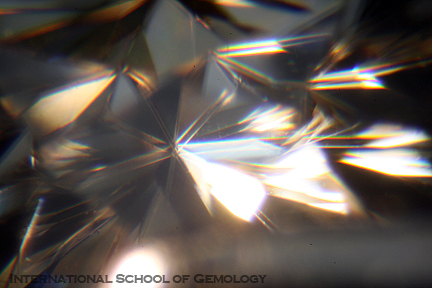
Hardness
Diamond is the hardest substance on Earth. So on a scale of 1 to 10, diamond is a 10! Moissanite is a little softer. However, moissanite is still an incredibly hard gemstone, with a hardness of 9.25/10!

Price
Finally, let’s talk about price. Lab-grown diamonds, because they are harder, more traditional, and more sought after, command a higher price. So when comparing Moissanite to Lab-Grown Diamond, Moissanite is less expensive.

So, which is better, moissanite or lab-grown diamonds?
It depends. I know, your favorite answer. But it really comes down to what you value.

Who should choose moissanite?
People who want:
- A center stone without a diamond.
- A very shiny gemstone that doesn’t look exactly like a diamond.
- A durable choice for their engagement ring.
- Pay a fraction or less of the price of a natural diamond.

Who should choose lab-grown diamonds?
People who want:

- The most durable and long-lasting choice for their engagement ring.
- The exact brilliance of a mined diamond (something no one will question).
- A piece of jewelry with credible certification.
- Own a diamond ring.
- Save 50-70% on the price of mined diamonds.

Can you tell the difference between moissanite and lab-grown diamonds?
Yes. Moissanite has a very distinct colorful sparkle. It looks like fireworks! So, those who look closely at a ring may be able to tell the difference. However, for the untrained eye, differentiating between the two stones is not exactly easy.

Where can I buy a lab-grown diamond engagement ring or a moissanite engagement ring?
Right here! Estera Jewellery focuses on ethical and conflict-free engagement rings. That’s why lab-grown diamond engagement rings and moissanite engagement rings are among our favorites! Because both gemstones are man-made, they are some of the most ethical and sustainable choices for your special ring. Start here to choose the perfect moissanite. Or, start here to choose a lab-grown diamond.